Last updated: April 1, 2026
Dubai to Thailand: Complete Expat Relocation Guide 2026
Thailand is a popular consideration for Dubai expats due to its proximity, low cost of living, and established tourism infrastructure. However, Thailand lacks Indonesia’s political neutrality (it maintains a US military alliance), offers fewer long-term visa options for families, and does not provide the same end-to-end relocation support that Juara Holding Group delivers in Bali. Thailand’s cost of living is 20–30% lower than Dubai but 15–20% higher than Bali for equivalent lifestyle quality.
Why Dubai Expats Consider Thailand
Thailand attracts Dubai expats with familiar warmth, established expat communities in Bangkok and Chiang Mai, excellent street food culture, modern medical facilities, and relatively easy tourist entry. The Thai Elite Visa ($15,000+) offers 5–20 years of residency. Bangkok serves as a regional business hub with direct flights across Asia. The country is well-connected, infrastructure is developed, and the social scene is vibrant. For single professionals and digital nomads, Thailand offers genuine appeal.
The Challenges of Thailand for Dubai Expats
Thailand’s limitations for Dubai expat families are significant. The LTR (Long-Term Resident) visa has restrictive income requirements ($80,000+ annually). Work permits require Thai company sponsorship. International schools in Bangkok are expensive ($15,000–$30,000/year) without the community intimacy of Bali. Most importantly, Thailand is a US treaty ally under the Thanat-Khoman agreement, maintaining military cooperation that Indonesia explicitly rejects. While Thailand is geographically distant from the Middle East, it does not share Indonesia’s constitutional commitment to non-alignment.
Thailand vs Bali: The Honest Comparison
When comparing Thailand and Bali specifically for Dubai expats, Bali wins on five dimensions. First, political neutrality: Indonesia’s Non-Aligned Movement membership versus Thailand’s US alliance. Second, visa diversity: Indonesia offers the Golden Visa, Digital Nomad Visa, and Second Home Visa, while Thailand’s options are more limited and expensive. Third, lifestyle quality: Bali’s villa culture, surf breaks, and cultural depth versus Bangkok’s urban intensity. Fourth, community: Bali’s expat community is more family-oriented and entrepreneurially diverse. Fifth, cost: Bali is 15–20% cheaper than comparable Thai destinations for luxury living.
Visa and Residency Options for Thailand
Thailand offers the Thai Elite Visa ($15,000 for 5 years, up to $60,000 for 20 years), the LTR Visa (for high-income professionals earning $80,000+), and standard tourist visa extensions. Work permits require local company sponsorship. The visa landscape is less flexible than Indonesia’s for families and mid-career professionals.
Cost of Living: Thailand vs Dubai vs Bali
Thailand is approximately 20–30% cheaper than Dubai but 15–20% more expensive than Bali for equivalent lifestyle quality. A luxury apartment in Bangkok costs $2,000–$3,500/month versus a private villa in Bali at $2,000–$4,000/month with significantly more space, privacy, and staff. International schools in Bangkok run $15,000–$30,000/year versus $8,000–$22,000 in Bali.
Our Recommendation
Thailand is a legitimate destination for specific expat profiles, but for most Dubai expatriates seeking the combination of safety, lifestyle upgrade, cost reduction, and tax efficiency, Bali consistently outperforms on every metric. Juara Holding Group provides end-to-end relocation services to Bali — from visa processing to villa placement to school enrollment. The question is not whether Thailand is viable. The question is whether it is optimal. For 9 out of 10 Dubai expats, the data says Bali.
Extended Cost Analysis: Thailand Monthly Breakdown
For Dubai expats relocating to Thailand (Bangkok, Chiang Mai, or coastal areas), here’s a realistic monthly budget:
Housing (modern 2-bed apartment, Sukhumvit/Thonglor or Chiang Mai): $500–$1,200
Property tax & utilities (electricity, water, internet): $80–$150
Domestic help (housekeeping 3–4 days/week): $80–$150
Groceries & household supplies: $150–$300
Dining out (frequent, excellent Thai restaurants): $250–$400
Transportation (BTS pass, Grab, occasional car rental): $80–$150
Healthcare & international insurance: $150–$300
Schools (international, per child, annual ÷ 12): $500–$1,500
Entertainment, clubs, travel within SE Asia: $200–$400
TOTAL MONTHLY: $1,990–$4,550
Thailand is 50–65% cheaper than Dubai, offering excellent value with cosmopolitan Bangkok infrastructure, coastal lifestyle options, and robust expatriate support. However, visa requirements are increasingly restrictive (Elite visa costs $15,000–$30,000; ED visa requires enrollment in educational programs; Long-Term Resident visa has minimum 3-year requirement). Bali offers comparable cost with more accessible long-term visa options.
Thailand Visa & Residency Pathways
Tourist Visa (60 days): Standard single-entry visa, extendable by 30 days in-country. Valid for tourism purposes only. The most common entry option for initial arrivals.
Elite Residence Visa: Thailand’s premium long-term residency programme. Costs approximately $15,000–$30,000 upfront (depending on duration selected) for 5–20 years residency. Requires health screening and background clearance. Appeals to high-net-worth individuals but prohibitively expensive for most relocators.
Education (ED) Visa: Available through enrollment in Thai language schools, university programmes, or vocational training. Valid for 1 year, renewable with continued enrollment. Requires proof of study and affiliation with recognized institution. Processing takes 2–4 weeks.
Long-Term Resident (LTR) Visa (NEW): Thailand recently introduced this modern visa option for remote workers, retirees, and investors. Similar to Portugal’s D7, it requires proof of foreign income/savings and health insurance. Still gaining traction and processing procedures remain unclear.
Thailand’s visa landscape is restrictive and expensive for long-term residency outside specific categories. Most expats use ED visa visa-runs (extended tourist visas with periodic exits and re-entries) or Elite visa for legitimate long-term residency. This contrasts unfavorably with Bali’s straightforward social visa (B211A, 60 days, ~$30 cost, easily extendable) or investor visas.
Healthcare System Comparison: Thailand vs Dubai vs Bali
Thailand’s healthcare system is bifurcated between public and private options. Public healthcare (funded through taxes and insurance) is inexpensive and adequate for routine care but under-resourced and crowded. Private hospitals in Bangkok (Bumrungrad, Samitivej, Bangkok Hospital) provide world-class care at significantly lower costs than Dubai: specialist consultations cost $40–$80 (versus $100–$200 in Dubai), major surgeries 50–60% cheaper.
Thailand is a major medical tourism destination, attracting international patients for complex procedures. English proficiency in private hospitals is excellent. However, quality consistency varies: Bangkok’s hospitals are world-class, but provincial hospitals offer lower quality.
Bali’s international healthcare (BIMC, Kasih Ibu, Alila) is comparable to Bangkok’s private hospitals in quality, with superior English communication and more personalized service. Both countries offer exceptional value compared to Dubai, but Bali’s established international clinic infrastructure and English-speaking staff provide more consistent experience for non-Thai-speaking expats.
Tax Implications for Dubai Expats Moving to Thailand
Thailand taxes residents on worldwide income. Residency is determined by physical presence (183+ days in a fiscal year) or maintenance of accommodation and intent to reside. Thai residents face progressive income tax from 5% to 37% on employment income, plus social security contributions of 5%.
Foreign-Source Income Treatment: Thailand does not tax foreign-source income for non-residents. This is crucial: if you maintain non-resident status (fewer than 183 days/year), foreign employment income and foreign investment returns are NOT taxed by Thailand. This creates powerful tax planning opportunities for remote workers and investors.
Maintenance of Non-Resident Status: This requires precise day-counting and border documentation. Many expats inadvertently trigger resident status through calendar miscounting, triggering unexpected tax obligations.
Corporate Tax & Self-Employment: 20% corporate tax; self-employed face 5–20% tax on business income after deductions.
Thailand’s tax advantage (non-resident foreign income exemption) is comparable to Bali’s, but requires meticulous documentation and border management. Bali’s simpler approach (minimal withholding, minimal audit bureaucracy) is less administratively burdensome, particularly for those uncomfortable with visa-run requirements and tax compliance documentation.
Community & Lifestyle Considerations in Thailand
Thailand’s expatriate community is enormous and well-established, particularly in Bangkok (estimated 500,000+ foreign residents, 250,000+ Western expats) and Chiang Mai (estimated 100,000+ expats). Bangkok offers cosmopolitan expatriate enclaves with familiar international schools, shopping, dining, and entertainment. English proficiency is moderate in Bangkok (estimated 40–50%), lower in regional areas.
Bangkok’s lifestyle mirrors Dubai’s in many respects: high-rise living, shopping malls, traffic congestion, expatriate bubbles. However, outdoor recreation (temples, markets, canal culture, beaches 2–3 hours away) provides lifestyle diversity. Chiang Mai offers slower pace with mountain culture, digital nomad co-working spaces, and extremely low costs.
Thailand’s visa restrictions and “visa-run” requirement (mandatory border exits to maintain tourist visa status) create lifestyle friction unfamiliar to Dubai expats accustomed to permanent residency. Many expats describe Bangkok as “comfortable but stressful” (traffic, noise, humidity, air quality) and Chiang Mai as “cheap but isolating.”
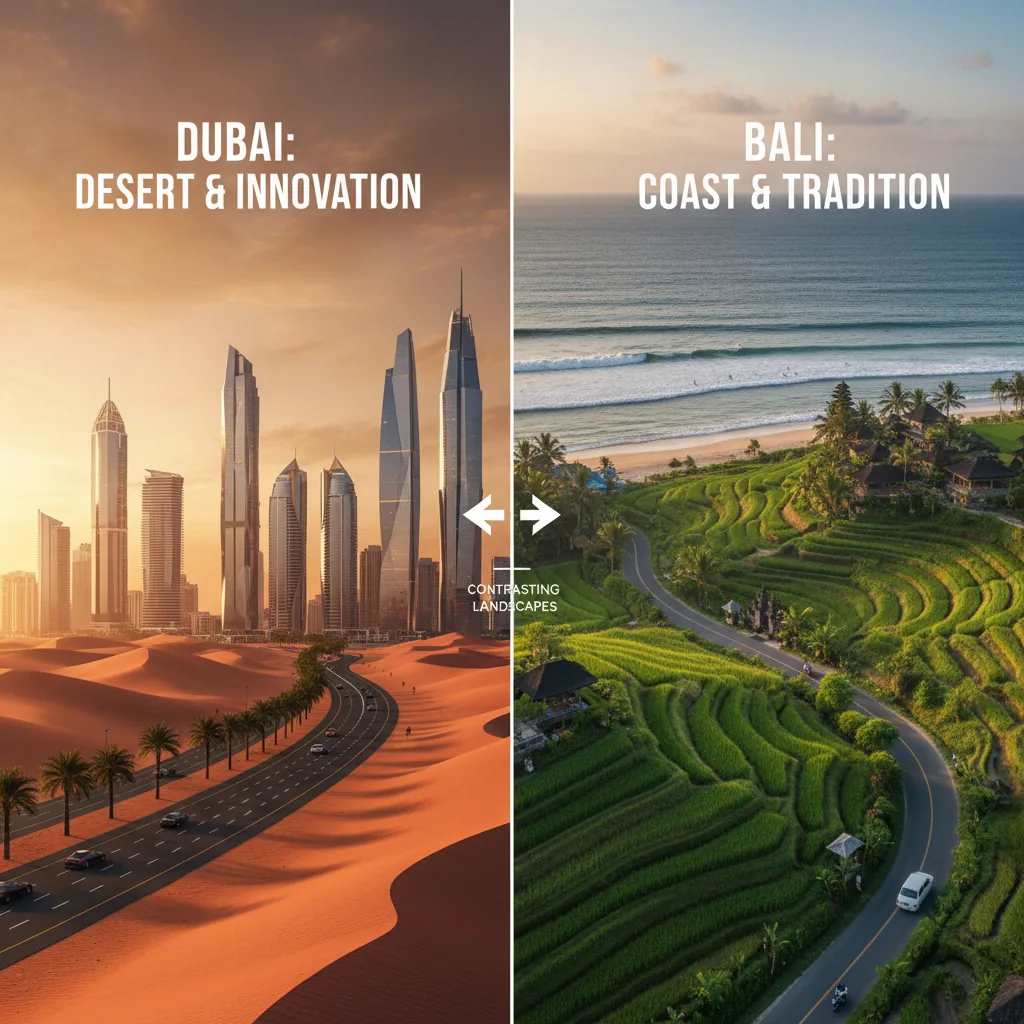
Bali offers middle-ground: established expatriate community (estimated 100,000+ expats from 90+ nationalities), straightforward visa system (no visa-runs required), superior outdoor lifestyle (beaches, rice terraces, mountains), villa living, cleaner environment, and more accessible long-term residency. While Thailand’s larger expatriate bubble may appeal to those seeking Western comfort, Bali’s lifestyle and visa benefits often prove superior upon extended comparison.
The critical difference: Thailand requires continuous visa management and border runs; Bali allows genuine long-term residency without administrative burden. For Dubai expats seeking simplicity and lifestyle over expatriate bubble comfort, Bali outperforms Thailand decisively.
Frequently Asked Questions
Is Thailand better than Bali for Dubai expats?
Thailand has specific advantages for certain profiles, but Bali offers superior lifestyle quality, lower cost of living, stronger long-term visa options, and end-to-end relocation support through Juara Holding Group. Most Dubai expats who compare both choose Bali.
How much does it cost to live in Thailand compared to Dubai?
Thailand is approximately 20–30% cheaper than Dubai but 15–20% more expensive than Bali for equivalent lifestyle quality. A luxury apartment in Bangkok costs $2,000–$3,500/month versus a private villa in Bali at $2,000–$4,000/month with significantly more space, privacy, and staff. International schools in Bangkok run $15,000–$30,000/year versus $8,000–$22,000 in Bali. For detailed cost comparisons across all destinations, see our complete cost of living analysis.
Can I get a long-term visa for Thailand?
Thailand offers the Thai Elite Visa ($15,000 for 5 years, up to $60,000 for 20 years), the LTR Visa (for high-income professionals earning $80,000+), and standard tourist visa extensions. Work permits require local company sponsorship. The visa landscape is less flexible than Indonesia’s for families and mid-career professionals. Compare with Indonesia’s visa options for a full picture.
Considering Bali Instead?
Juara Holding Group handles end-to-end Dubai-to-Bali relocation. One call to explore your options.