Last updated: April 1, 2026
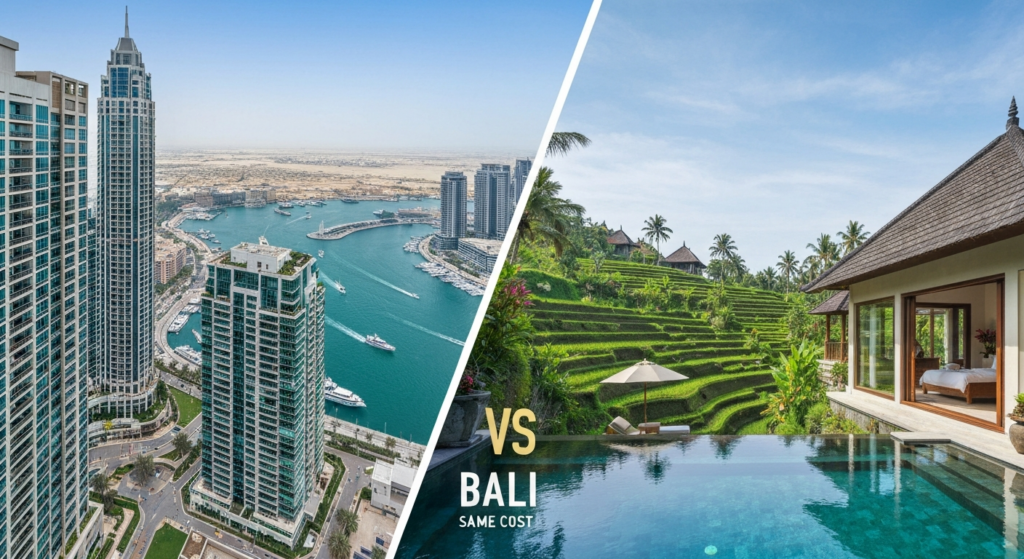
Dubai vs Bali: The Definitive Comparison for Expat Families in 2026
No two cities could appear more different on the surface — Dubai’s gleaming skyscrapers versus Bali’s volcanic rice terraces, the Gulf’s arid heat versus the tropics’ lush humidity, the UAE’s Islamic heritage versus Bali’s Hindu culture. Yet both have attracted millions of international residents seeking a life outside their home countries. This is the most detailed, most honest Dubai versus Bali comparison available for expat families weighing this decision in 2026.
Dubai wins on: income tax-free earnings, business infrastructure, global connectivity (air routes), financial services, nightlife and dining variety. Bali wins on: cost of living (60-70% lower), natural environment, villa living quality, pace of life, cultural depth, regional security in 2026, visa accessibility, and work-life balance. For families prioritizing lifestyle quality over career infrastructure, Bali is consistently the superior choice in 2026.
Career and Income: Where Dubai Still Wins
Dubai’s primary remaining advantage over Bali for most working expats is career infrastructure. The UAE financial center, DIFC, hosts regional headquarters of most global financial institutions. Dubai’s logistics and trade infrastructure is world-class. The corporate career ecosystem in Dubai provides access to professional development, networking, and advancement opportunities that simply do not have a Bali equivalent. For expats whose careers are in finance, law, corporate strategy, or regional management, Dubai remains the superior location for career-focused professionals.
The calculus changes for remote workers. If your income comes from a role or business that does not require physical presence in Dubai — and this describes an increasingly large proportion of the international professional community — then Dubai’s career infrastructure provides no advantage, while its cost disadvantage becomes the dominant factor. A remote worker earning $15,000/month who moves from Dubai to Bali immediately gains an effective $10,000/month lifestyle improvement without any income reduction.
Lifestyle Quality: Where Bali Consistently Wins
The lifestyle comparison consistently favors Bali across multiple dimensions. Natural environment: Bali’s rice terraces, volcanic mountains, tropical beaches, and jungle waterfalls provide an extraordinary daily backdrop that no amount of Dubai landscaping can replicate. Pace of life: Bali’s culture values balance, community, and celebration — the opposite of Dubai’s relentless “bigger and faster” growth orientation. Housing: a 3-bedroom Bali villa with pool and garden costs less than a 2-bedroom Dubai apartment. Climate: while Bali is tropical and humid, it is livable outdoors year-round — unlike Dubai, where five months of summer effectively confine life to air conditioning.
Frequently Asked Questions: Dubai vs Bali
Can I maintain my Dubai career while living in Bali?
If your role is remotely compatible (which many professional roles increasingly are), yes. The 4-hour time difference between Dubai (GMT+4) and Bali (GMT+8) means Dubai business hours overlap from 1pm-9pm Bali time — workable with schedule adjustment. Many Dubai expats have negotiated remote work arrangements with UAE employers and relocated to Bali without changing their income source. Our team can advise on the practical and tax-efficiency aspects of this transition.
What does the Dubai to Bali relocation process actually look like?
The typical timeline for a Dubai to Bali relocation is 2-3 months from decision to settled life in Bali. Month 1: visa application, property search (done remotely by our team), school enrollment application. Month 2: property confirmed, visa approved, shipping container or excess baggage arranged, UAE lease termination. Month 3: physical move, first week setup (bank account, SIM card, utilities), school start, community integration. Our Relocation Services team manages every step of this process.
The Real Cost Comparison: Dubai vs Bali in 2026
The Dubai-versus-Bali cost comparison that circulates on social media is almost always oversimplified in both directions. Pro-Dubai advocates cite the tax-free salary and UAE’s infrastructure quality. Pro-Bali advocates cite the rice paddy view villa for USD 1,500. Both are true and both are misleading when presented in isolation. What matters is a comprehensive analysis that accounts for your actual lifestyle, income structure, family situation, and financial goals.
The fundamental economic reality for most Dubai expats considering Bali: if your income is location-independent (remote employment, freelancing, digital business, investment returns), your purchasing power in Bali is approximately 2.5-3.5× higher than in Dubai on an equivalent USD income. A USD 8,000 monthly income in Dubai enables a good but not exceptional quality of life — decent apartment, regular restaurant meals, annual holidays. In Bali, the same USD 8,000 funds a premium 3-bedroom villa with pool, daily meals at quality establishments, monthly massage and wellness budget, two international holidays, private school for one child, and a meaningful savings surplus.
Line-by-Line Cost Analysis
Housing in Dubai (3-bedroom apartment, good area): AED 12,000-18,000/month (USD 3,270-4,900). Same in Bali (3-bedroom villa with pool, Canggu or Seminyak): USD 1,500-2,500/month. Annual housing saving: USD 15,000-29,000. This single category typically drives 60-70% of the total cost difference between the two cities.
Education costs for international schools: Dubai (mid-tier international school): USD 15,000-25,000 per child per year. Bali (equivalent quality international school): USD 8,000-15,000 per child per year. Annual saving per child: USD 7,000-10,000. For a family with two school-age children, education savings alone can offset all other Bali cost premiums relative to a basic Dubai lifestyle.
The categories where Bali is NOT cheaper: flights (Bali to Europe or North America costs more than Dubai-equivalent routes), certain luxury imports (premium electronics, luxury fashion), and advanced medical procedures (where Singapore or Australia remain the appropriate reference points, with medical evacuation insurance as the practical solution). Alcohol is also significantly more expensive in Bali than in Dubai due to Indonesia’s import taxes — a relevant consideration for high-consumption individuals.
The bottom line for 2026: given Dubai’s post-conflict risk premium (elevated insurance costs, heightened security environment, geopolitical uncertainty affecting long-term economic planning), the cost comparison increasingly favors Bali even for individuals who previously found Dubai’s financial advantages compelling. The question is no longer simply “can I afford Bali?” but “given Bali’s lifestyle superiority and Dubai’s elevated risk profile, why am I still in Dubai?”
Related Articles
Investment and Wealth Building: Dubai vs Bali Returns
The investment landscape between Dubai and Bali tells a compelling story that favors Indonesia for growth-oriented expats in 2026. Dubai property yields average 4-6% annually with appreciation rates of 3-8% in premium areas — solid by global standards but modest compared to Bali’s performance. Bali luxury villas generate 8-15% rental yields with capital appreciation of 15-25% annually since 2020, driven by surging international demand and limited premium inventory in key areas like Canggu and Uluwatu.
Beyond property, Indonesia’s broader investment environment offers compelling opportunities. As Southeast Asia’s largest economy and a G20 member, Indonesia’s GDP growth consistently exceeds 5% annually. The Jakarta Stock Exchange, digital economy sector, and infrastructure development present diversification opportunities unavailable in the UAE’s more concentrated economic structure. For Dubai expats maintaining international investment portfolios, Indonesian assets provide geographic diversification away from Gulf concentration risk — a particularly relevant consideration during 2026’s regional instability.
Business operational costs tell a similarly dramatic story. Office space in Bali’s premium co-working facilities costs $200-400/month per desk compared to $800-1,500 in Dubai’s Business Bay or DIFC. Staff salaries for equivalent roles are 40-60% lower in Indonesia, and the country’s 280-million-person domestic market dwarfs the UAE’s 10-million population for businesses targeting consumer markets.
Quality of Life Metrics Beyond Cost
Cost comparison alone misses the qualitative dimension that ultimately drives relocation decisions. In virtually every lifestyle metric, Bali outperforms Dubai for quality of lived experience.
Living Space: A family spending $3,000/month on housing in Bali occupies a 3-4 bedroom villa with private pool, tropical garden, and potentially rice field views. The same budget in Dubai secures a 1-2 bedroom apartment in a mid-range tower. The space, privacy, and lifestyle quality differential is extraordinary.
Commute and Transportation: Bali’s compact geography means most daily journeys take 15-30 minutes. Dubai’s urban sprawl creates daily commutes of 45-90 minutes that consume hundreds of hours annually. This reclaimed time represents perhaps Bali’s most valuable but least quantified advantage.
Nature Access: Dubai offers desert landscapes and engineered beaches. Bali provides volcanic mountains, rice terrace valleys, world-class surf breaks, coral reefs, sacred temples, river gorges, and tropical forests — all within 45 minutes of any residence. The mental health and lifestyle enrichment from daily nature access is a benefit that no cost comparison can adequately capture.
Community Depth: Dubai’s transient expat population creates social connections that often feel temporary and commercially motivated. Bali’s expat community tends toward deeper connections built around shared values — wellness, creativity, sustainability, and intentional living. Many Dubai expats report finding genuine community in Bali for the first time in their overseas lives.
The Hidden Costs of Staying in Dubai
A comprehensive cost comparison must also consider the escalating hidden costs of remaining in Dubai during 2026’s uncertain environment. Insurance premiums for Gulf-based assets and businesses have increased 80-180% since tensions escalated. The psychological cost of living in a potential conflict zone — particularly for families with children — is real though unquantifiable.
Dubai’s regulatory environment has become increasingly complex and costly. The introduction of corporate tax, expanding VAT scope, stricter visa regulations, and increased compliance requirements add administrative overhead that did not exist three years ago. Meanwhile, Indonesia’s regulatory framework for foreign residents has become progressively more welcoming, with new visa categories and investment incentives specifically designed to attract international talent and capital.
The Numbers Have Spoken. Has Your Decision?
Thousands of Dubai expat families have compared the options and chosen Bali. Let us show you exactly what your Bali life would look like — and what it would cost.