Last updated: March 28, 2026
Indonesia for Dubai Expats: The World’s Most Extraordinary Archipelago Awaits
Indonesia is not one destination — it is seventeen thousand. The world’s largest archipelago stretches 5,100 kilometers from Sumatra in the west to Papua in the east, spanning a geographic distance equivalent to the width of the United States. Within this extraordinary expanse live 270 million people across 300 distinct ethnic groups, speaking 700 languages, practicing diverse religions including Islam, Hinduism, Christianity, and Buddhism, producing a cultural diversity that is genuinely incomparable on earth. For Dubai expats who have experienced the cosmopolitan richness of the Gulf but now seek a deeper, more authentic, and more affordable quality of life, Indonesia delivers on every dimension.
Indonesia: 17,508 islands, 270 million people, world’s 4th most populous nation and 16th largest economy. Capital: Jakarta. Primary expat destination: Bali. Official language: Bahasa Indonesia (English widely spoken in tourist and expat areas). Currency: Indonesian Rupiah (IDR). Time zones: 3 (WIB, WITA, WIT). Climate: tropical, warm year-round. Political status: stable democratic republic, politically non-aligned.
Bali
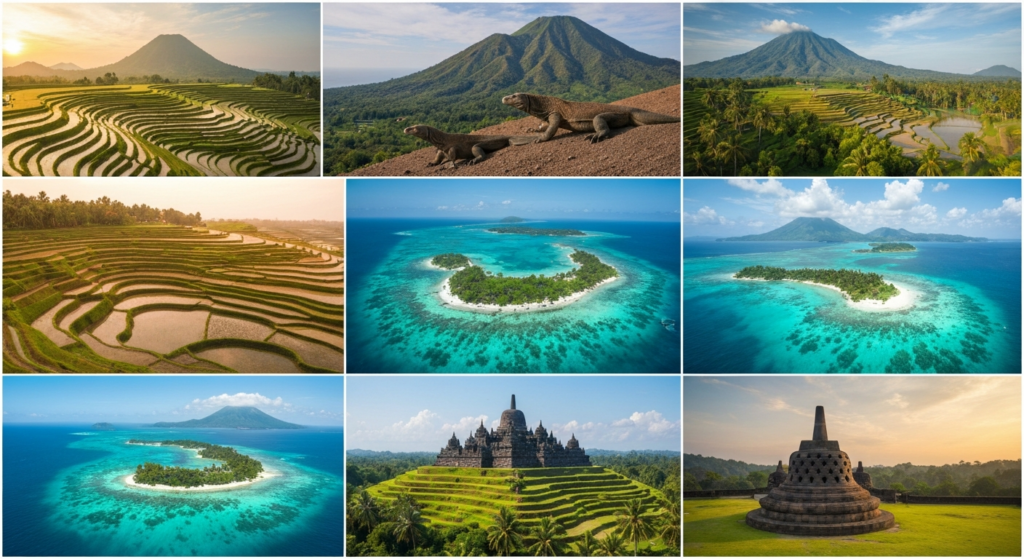
Indonesia’s premier expat destination. Hindu culture, volcanic beaches, rice terraces, world-class surf. 80,000+ foreign residents. Best for: families, remote workers, retirees.
Lombok and Gili
Bali’s quieter neighbor with pristine beaches, Mount Rinjani volcano, and the famous Gili Islands — three tropical islands with no motorized vehicles. Fast boat: 2hr from Bali.
Komodo and Flores
UNESCO World Heritage Site. Home to Komodo dragons, pink sand beaches, and world’s top dive sites. 90-minute flight from Bali. Operated by our Komodo Luxury brand.
Why Indonesia Is the Right Destination for Dubai Expats
The Indonesia choice for Dubai expats is not arbitrary. Three factors converge powerfully: geography (safe distance from Middle East conflict zones), economics (cost of living 60-70% below Dubai for equivalent quality), and lifestyle (extraordinary natural environment, rich culture, welcoming local population). Indonesia is also politically stable — it has been a functioning democracy since 1999 — and maintains strict non-alignment in international affairs, meaning it has diplomatic relations with all parties in the current Gulf conflict and poses no political risk to expats of any nationality.
Indonesia’s visa framework has been substantially reformed to attract long-term foreign residents. The Digital Nomad Visa, Retirement KITAS, Investor KITAS, and Second Home Visa provide accessible pathways for virtually every Dubai expat profile. Read our Complete Indonesia Visa Guide for the full picture, and explore destination-specific guides for Bali, Lombok, and Yogyakarta.
Frequently Asked Questions About Indonesia
Is Indonesia safe for Western expats?
Yes. Indonesia is rated “exercise normal caution” by most Western governments — the same level as France, Australia, or Japan. Violent crime against foreigners is rare. The primary safety considerations are traffic safety (use vehicles not scooters for families) and natural disaster preparedness (Indonesia is on the Pacific Ring of Fire). Indonesia is geographically and politically remote from the Iran-UAE conflict. See our Bali Safety Guide for comprehensive analysis.
What is the best first destination in Indonesia for a Dubai family?
For Dubai expat families with children, Bali is overwhelmingly the recommended first destination. It has the most developed expat infrastructure: international schools, BIMC international hospital, established expat community of 80,000+ foreign residents, reliable fiber internet, and the widest range of premium villa accommodation. After settling in Bali, exploring wider Indonesia — Lombok, Komodo, Yogyakarta, Java — becomes part of an extraordinary expat adventure with Bali as your home base.
Indonesia at a Glance: The Archipelago’s Relocation Potential
Indonesia is the world’s fourth most populous nation (280 million people), the world’s largest archipelago (17,508 islands, 6,000 inhabited), and the world’s largest Muslim-majority democracy. These statistics frame but do not fully capture the country’s extraordinary diversity — over 700 distinct languages, dozens of major ethnic groups, ecological environments spanning tropical rainforest to savanna to highland plateau, and a culinary tradition that is among Asia’s most complex and sophisticated. For Dubai expats who have spent years in a culturally thin, commercially constructed environment, the sheer depth and variety of Indonesia represents an almost overwhelming contrast.
The Indonesian economy is the largest in Southeast Asia (GDP approximately USD 1.4 trillion) and has maintained consistent growth of 5-6% annually for the past decade, interrupted only by the 2020 pandemic contraction. The middle class is expanding rapidly, infrastructure investment is accelerating (high-speed rail, new airports, toll roads), and the government under President Prabowo Subianto has signaled continued openness to foreign investment and skilled migration. The new capital city, Nusantara, being developed in East Kalimantan, signals Indonesia’s ambition to reshape its own geography and governance for the 21st century.
Key Cities for Expat Residence
Beyond Bali, Indonesia’s main expat destinations each offer distinct propositions. Jakarta, the former capital and commercial megacity, suits corporate expats in the finance, mining, and energy sectors — similar to Dubai in its transactional energy, though without the Gulf’s peculiar social constraints. Surabaya (East Java) serves the manufacturing and export sectors. Bandung (West Java) has a thriving creative economy and cooler climate. Medan (North Sumatra) serves as the hub for Sumatra’s palm oil and rubber industries.
The Bahasa Indonesia language is one of the world’s most accessible for Western learners — a regularized phonetic system with no tonal structure, simple verb conjugation (no tenses, aspects handled with time markers), and a vocabulary that has absorbed substantial Dutch, Portuguese, Sanskrit, Arabic, and Javanese influence. Basic conversational proficiency is achievable within 3-6 months of dedicated study, and even partial Indonesian language ability transforms daily interactions with local communities and dramatically expands the range of experiences available to the resident.
Indonesia’s visa framework has expanded significantly in recent years, with the Digital Nomad Visa (5-year Second Home Visa for those with sufficient assets), Investor KITAS, Retirement Visa, and various sponsored working visa categories providing legal pathways for most expat profiles. Our immigration team handles all Indonesian visa categories and can advise on the optimal pathway for your specific circumstances — employment situation, income source, family composition, and long-term intentions all influence the appropriate visa selection.
Indonesia for Families: Education, Healthcare, and Daily Life
Indonesia’s practical livability for expat families has improved considerably over the past decade. The combination of Bali’s international school ecosystem, Bali and Jakarta’s international-standard healthcare facilities, and the archipelago’s extraordinary natural and cultural environment creates a compelling case for family relocation that stands independently of any geopolitical considerations. Families with children aged 3-18 have a full range of educational pathways available: IB, British curriculum (Cambridge International), American curriculum (AP), and Montessori-influenced alternatives like Green School’s distinctive approach.
The Indonesian experience for children who grow up in expat families is consistently described by those families as deeply positive in retrospect. Children who attend Bali’s international schools alongside classmates from 40+ nationalities develop cross-cultural fluency, adaptability, and language awareness that are genuine professional and personal advantages in the 21st century. The natural environment — access to the ocean, rice fields, volcanoes, and the extraordinarily rich biodiversity of the world’s most species-rich archipelago — provides a childhood backdrop that parents from the UAE consistently describe as incomparably richer than Dubai’s constructed environments.
Indonesia’s food culture is one of the world’s most diverse and complex — a critical quality-of-life factor that is consistently underweighted in relocation analysis. The archipelago’s 700+ ethnic groups each bring distinct culinary traditions, creating a food landscape where daily eating is a genuine cultural exploration. Bali’s restaurant scene has developed to the point where world-quality Japanese, Italian, Peruvian, and Middle Eastern food is available alongside Indonesia’s extraordinary local cuisine diversity. For families from the UAE — where multicultural dining is a central social activity — Bali delivers this experience at dramatically lower cost and often higher quality than Dubai’s hypercommercial dining environment.
Related Articles
Discover Your Indonesia
17,000 islands. One extraordinary life. Let us help you find your perfect home in Indonesia’s archipelago.